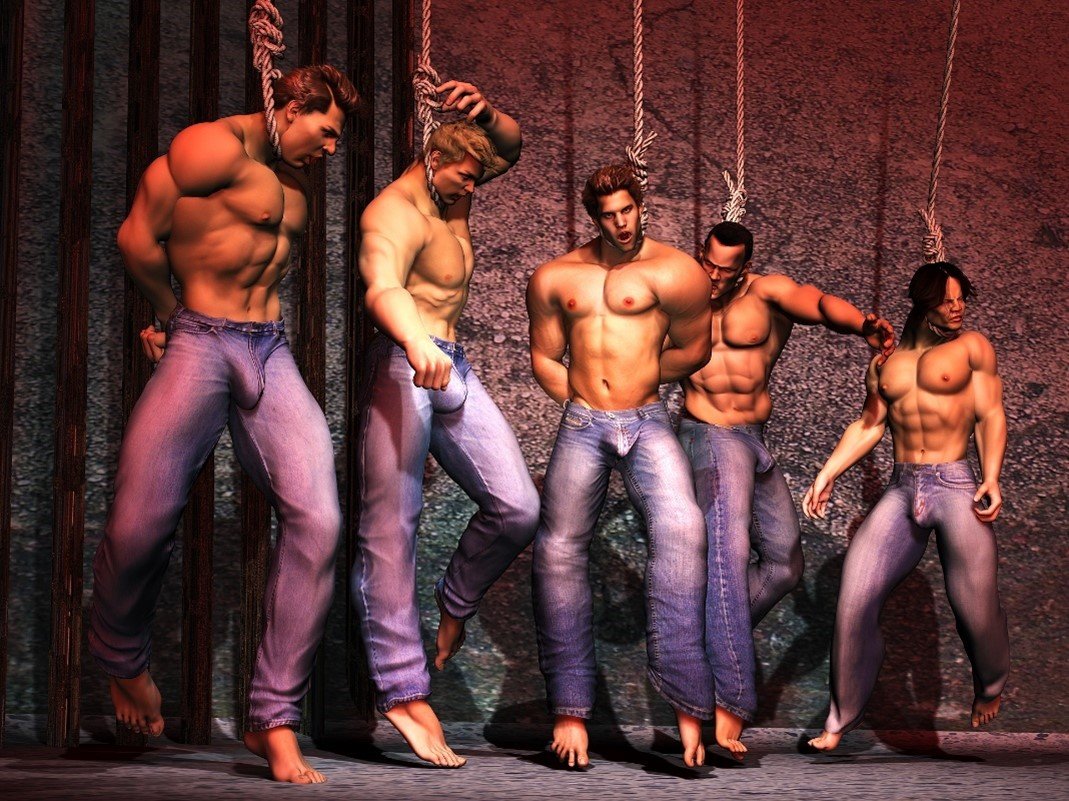
Five cowboys wearing only tight blue jeans struggle desperately to free themselves from individual nooses pulling them up, up, up by their thick necks. Their wildly kicking legs extend downward trying to touch the floor to prevent—if only temporarily—the slow, humiliating, suffocating death that each man inevitably will endure from this suspension hanging party.
One of the doomed cowboys cries out in his mind, “We’re all hung!” Because they are dying together, all five of these men are linked mentally and are aware of each other’s final thoughts. A second cowboy hears the first one and in his mind answers back, “I think you mean hanged.” The third cowboy thinks, “No, he’s saying he thinks we all have huge cocks.” The fourth one has this thought: “Which we won’t ever get to use again!” The fifth cowboy is so preoccupied with sobbing he cannot think at all.
All these young cowboys struggle in obvious pain and terror as they attempt to free themselves from their nooses. But they cannot escape the inevitable. They all try to shout out, but their throats are constricted by the ropes and no air is moving up from their lungs. They only make strange, very muted hissing sounds that mean nothing. Yet the pain on their handsome faces conveys far more than words ever could. They each look like they know for certain they are going to die.
There is a small crowd of mostly male audience members observing this execution. They applaud enthusiastically and shout out obscene phrases indicating their strong approval of the ritual execution happening before their eyes. All five cowboys jerk and flop around like a group of fish yanked suddenly by fishermen out of water into the open air. But these cowboys are well past the point of enjoying air.
A color photograph captures the last few seconds the five cowboys were alive. The top half of the picture, however, is missing due to image file damage. A documentary narrator’s voice says in a matter-of-fact tone, “That damaged photograph depicting the brutal deaths of five cowboys led to many findings.” A man’s hands hold a color printed copy of the photograph in standard 8 and a half by 11-inch format up to the documentary camera. “The original was in digital format only,” the documentary narrator says. “This is merely a replica. You can clearly see the upper left of the photograph is gone. The original image file was held for a time in a museum in Geneva, Switzerland, but has since been lost.”
An older male with gray hair and a full beard dressed in a white laboratory outfit while seated in an office in front of bulging bookshelves is identified on the screen as Richard Montgomery of the International Museum of Geneva. He speaks English with a heavy French accent as he explains, “I examined the original digital file. But now that file cannot be found. It may have been stolen. The artifact was a common image file. It did not show any indications of having been manipulated. The damage to the file also seemed genuine and not faked.”
The documentary narrator explains as a close-up of the image of the hanged young men moves across the screen: “They all would have died not long after being lifted upwards by the ropes around their necks. Nobody can survive against the relentless force of gravity when the neck is crushed by a noose that tightens as it is pulled downward by a man’s full body weight.”
There are several elements that damaged photograph can reveal to any observer: All five men appear to be under the age of 30. They all are shirtless, their feet are bare, and each wears only blue denim jeans. Did they wear the jeans as costumes for some reason? Or, did these men work as actual cowboys?
A young male viewer is watching this documentary on a large, flat screen in a darkened room by himself. He responds to what he’s seeing with eyes open very wide in utter astonishment.
The documentary narrator says, “That photo was found in wreckage of what apparently was a military base on the moon deep intentionally buried deep within the crater Clavius.” Full color still photographs of the underground wreckage from various perspectives are displayed on the documentary screen as the narrator says, “Explorers inside the wrecked lunar base which had been nicknamed ‘Baja Clavius’ captured these images showing very little exists there today. There were no human remains found anywhere in these ruins. But scientists say that’s easy to explain: Human remains would have been ejected into the vacuum of space. The moon has no atmosphere. But in direct sunlight the temperature at crater Clavius can reach 260 degrees Fahrenheit, twice as hot as any desert here on Earth. All human life at the lunar base was ended abruptly by an apparent explosive decompression that scattered evidence across the white/grey powdery floor of crater Clavius.”
The young male viewer responds by vomiting freely into his own lap but he cannot take his eyes off that documentary. No long afterwards he walks into an office with neon blue-grey lighting bouncing off leathery walls the color of chocolate milk. There in front of a contemporary glass desk is the person with whom he has an appointment. Is the psychiatrist male or female? The young man seems puzzled. Ev Grant could be a man’s name. Doctor Grant’s facial features are obscured by shadows, as if deliberately so. The doctor’s giggle suggests masculinity, but—.
Doctor Grant’s first words to the new patient are: “Welcome. Please sit down. Let me see. You turn 18 next Friday. The forms you filled out say you watched a documentary about the moon. Now you’re experiencing nightmares.”
“Yes. Thank you for seeing me on such short notice,” the young man says politely as perspiration forms on his forehead. “I thought perhaps I may have dreamed of that moon documentary. Not sure I actually saw it. One dream causes another dream—that kind of thing. But I remember very detailed and quite vivid things from my dreaming. Not what usually happens. Actual words. Specific images. Rarely are my dreams so lifelike. Plus, the knowledge conveyed is not stuff that I know anything about at all.”
“Tell me what you experienced. I want to understand from your point of view. Your forms say it was on very late—around two in the morning. The moon documentary. You were scanning through the channels when you noticed the documentary was starting.”
“Yeah, exactly. I probably missed just the first few seconds. I don’t know for sure. When I landed on that science channel, I saw the opening titles of the documentary. I remember the narrator’s reassuringly deep and confident voice. He said, ‘The crater Clavius has given up many secrets deep inside the moon.’ That’s what caught my attention and I watched the whole hour. On the screen was an unforgettable close-up of that crater from lunar orbit.”
“Is that particular crater significant to you?”

“Yeah, because of the film, 2001: A Space Odyssey.”
“So, you’re interested in very old movies?”
“Well, that one, yeah. From very long ago—1968. I bought a special restored and remastered version that came out for to celebrate the 230th anniversary of the film’s release. I didn’t even care how much that cost me.”
“Had you ever heard of the crater’s name before you first saw that old movie?”
“No, of course not. But that’s not important. The name of the documentary was very strange to me. Sarcastic. As if someone thought it would get attention.”
“Can you explain for me what you mean?”
“Uh, the documentary is recent, from 2198. I think that was when it was released. Anyway, the narrator in that documentary said a photograph was found under that crater. Amid wreckage of some underground structure that descended downward 20 or 30 stories. A top-secret military base nobody ever heard about. The photo got nicknamed ‘Clavius Cowboys’ because of what it depicted. That’s the name they gave to the documentary.”
“Did you see the photo in the documentary?”
“Five cowboys. I saw it, yeah. They apparently were being hanged by the neck with rope like how cowboys were executed during the 19th century. In the American West. But the photograph was partially damaged. No way to identify the hanged men due to that damage.”
Doctor Ev Grant asks, “Your nightmares are about you being hanged like you saw in that photo?”
“I don’t remember dreaming about being hanged, no,” is the reply.
“How would you describe the intense feelings of fear in your nightmares if you did not dream of your own death by hanging?”
“I think the fear comes from what I imagine are behaviors of people who hanged those five cowboys.”
“What people are you referring to?”
He replies, “The ones who lived on after they executed those five cowboys. It’s all explained in the documentary.
The documentary narrator says, “In addition to that ‘Clavius Cowboys’ image, one other electronic artifact found was tantalizing portions of a personal log left by a man who lived and worked within a destroyed military base located far below the crater Clavius. The author of that journal tells of a fantastic underground operation on the moon that will seem to most people as though it was pure science fiction.”
The documentary screen shows a deep stairwell of metal steps descending downward. The documentary narrator says, “The remnants of the man’s personal log found in the lowest levels of the lunar wreckage does not pinpoint when the base was built or what purpose there was for locating a top-secret military base on the moon in the first place. The exact date of the destruction of the base took place is also not known. But, the portions of the personal log that survive suggest that some sort of violence between two opposing groups of men at base explains why all its human occupants are now gone.”
Doctor Ev Grant asks, “So you have had recurring nightmares that have something to do with that lunar base being destroyed?”
“Yes,” the young man replies with tears welling up in his eyes.
“Bad men. A very lonely location. Doing harm to other men as a result,” the young patient explains to Doctor Grant. “Hurting each other. Killing one another.”
“And because of your nightmares, you fear that harm will come to you?” Doctor Grant asks.
“No, of course not. They’re all dead now. I’m sure that my fear is irrational. The documentary said the violence was caused by opposing religious views the men at the base held. Not like any religions we know here on Earth. A new kind. The men who lived beneath the crater in that military base who were religious went after those who would not convert to the new religion. Tortured them. Killed them. I’m not crazy, Doctor Grant. I do not perceive that I’m connected to their religion or threatened by it in any way.”
“I’m glad that you understand,” Doctor Grant explains. “Fear linked to religion is very common. There has been violence and killing based on religions for many centuries. Ironic, of course. Most religions claim that they exist to bring people’s faith into focus and to honor a deity or some universal truth while encouraging peace. Religion is supposed to be a relaxing and pleasant or positive experience. But many religious experiences end up causing hurt. And some even cause death to those who are nonbelievers.”
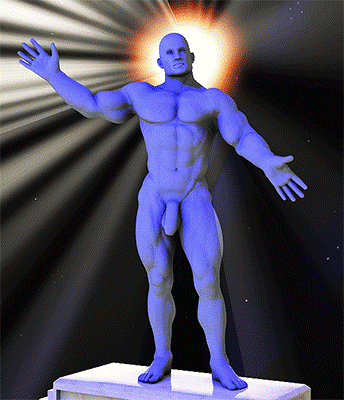
“The documentary said that’s what happened on the moon. A totally new religion. Started at that lunar base. But quickly made it here to Earth. This new religion supposedly was connected to a discovery on the moon about extraterrestrial life,” the young man explains. “Here on Earth—I think the documentary said it was Geneva—a giant blue statue was created by a Portuguese artist from the Azores Islands. I think the statue on display in Switzerland was meant to represent the new religion started on the moon.”
As the screen shows color photographs of the underground wreckage, the documentary narrator says, “The personal log tells about men working underground on the moon. A group of men started a new religion intended only for the men who lived and worked at the base beneath the lunar surface. The religion was based on the belief that a new nonhuman species far superior to humanity had been discovered in a far distant galaxy—too far away from Earth so that nobody from our planet will ever go there in person. The new religion started on the moon was not connected to most terrestrial religion concepts of what can be called an almighty god. This moon religion was not built upon the presumption of any interventionist higher power. Something else. Something from a far-off galaxy. Some of the crew members on the moon were thought to have become holy men. Several believed these holy men could float in the air and perform miracles such as repairing damaged skin or broken bones.”
The Geneva statue appears on screen for an extended segment within the documentary. The name of the Portuguese artist who created the statue is mentioned by the narrator.
Doctor Grant says, “I’m sure that’s all just speculation. That’s my take on it. Imaginary powers. A powerful entity out there somewhere beyond our planet who was invented by human beings. This is a very familiar story.”
“You’re saying all religions are the same? Everyone on Earth who is religious has chosen to believe in false gods? Created by mortal men for reasons we may never understand.”
Doctor Grant replies, “Well, some things we can learn from studying history. Ancient Roman leaders used pagan religion to control the people throughout the empire. Religion created by Rome using legendary names known through was intended to serve the growth and stability of their empire, for example. Religions all have at least one common denominator of folklore. Many common elements appear in many religions like virgin birth, crucifixions, resurrection from death, miracles and on and on. Belief in powerful, invisible beings created by mankind to manipulate and control people using fear of the unknown. Listen to me. You and I live in the present day. This is 2200. Not at all like the era of ancient Rome. We’re advanced in our thinking. Or so we choose to believe. You understand what I’m saying to you? Today we have no primitive beliefs and multiple gods because we don’t really need any. It’s that simple. But some people today still cling to religions from the past even in what we think of as our logical or rational civilization. Doing so seems to make some people feel better if they cling to the past. Safer. More reassuring. Less unpredictable or random.”
“What about my nightmares? I don’t want them to continue.”
“Well, I definitely can help with that. To start, I can prescribe 30 minutes of mental massage for you. No drugs. Instead it’s a very relaxing experience. Sort of like a ‘brain vacation’ for you. Hook you up at the center. Just downstairs. They put a lightweight device on the top and back of your head. Feels great. If you like it, and you want more, let me know. You’re covered for those treatments one hundred percent up to about fifty or so sessions. You won’t need that many sessions, I’m sure. I believe your nightmares will pass quickly once you’re in that brain treatment program.”
The young patient nods in acceptance and manages to smile tentatively.
The documentary camera zooms in on the damaged image of the five hanged cowboys and the narrator explains, “Perhaps the truth about this image is that it depicted some sort of religious ritual. A human sacrifice. Like in ancient times. To appease what was thought to be some angry deity, religious leaders took human lives. Often involving beheadings of infidels. Or, hanging young disbelievers by their necks until they were dead. Just for refusing to accept the teachings of the elders.”
In a dramatic recreation for the documentary the man who leads the religious zealots on the moon is not yet 30. He is Asian and muscular. He conveys a strong sense of determination by the unfriendly expression on his face. “You have two choice. Only two. Listen carefully.”
Kneeling naked in front of the religious leader with his wrists bound behind his back is a young man. He nods in understanding.
“The two choices,” says the religious leader, “If you convert to this new religion, your life will be spared. My men will force you to ejaculate as your wrists remain tied behind your back.”
“No,” the naked young man says with desperation in his voice.
“Your ejaculation in front of us is a sacrament. Our holy sacrament. It is both release and obedience. Together in one moment. When you ejaculate, you complete this sacrament, you will become one of us. We will welcome you and protect you from all nonbelievers. You will be safe with us for the remainder of your life.”
“No,” the naked young man repeats.
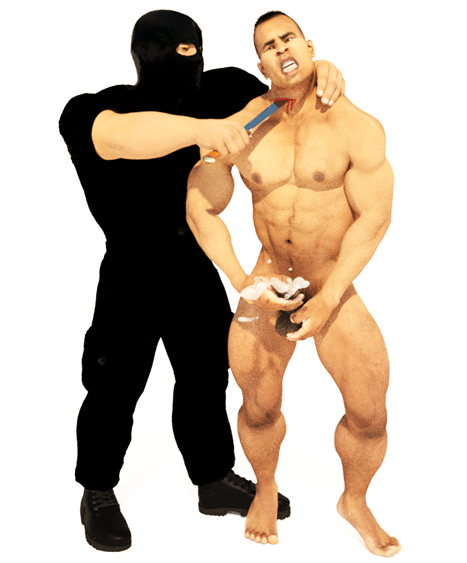
“The second choice is far less pleasant. You will be anally penetrated by my men as your wrists remain tied behind your back. You will be brought to climax against your will. You will celebrate our sacrament whether you want to or not. Then you will be castrated and brutally executed.”
The naked young man is sobbing as he struggles helplessly on his knees. “I await your decision,” the religious leader says softly. “No rush. Take your time.”
The voice of the documentary narrator explains, “Electronic records found in the wreckage below the crater report that crew members who formed the new religion for Baja Clavius were rounded up and executed one-by-one as the violence erupted that eventually resulted in the total destruction of the military base. All lives at the base were lost.”